


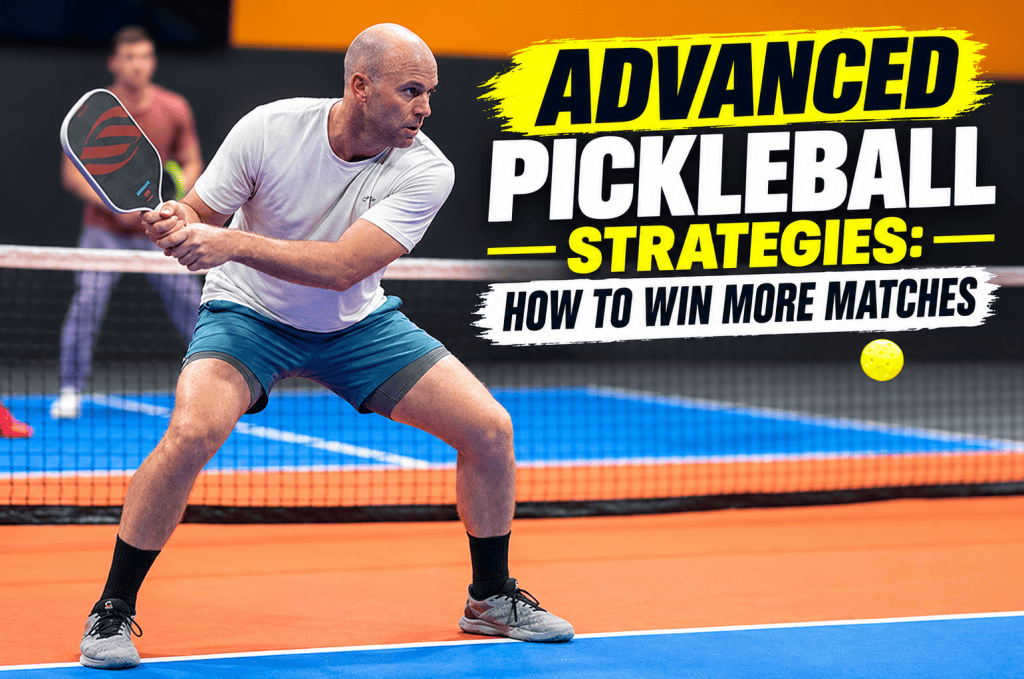
TL;DR: 5 Advanced Strategies to Dominate the Court
- Master the third shot drop: It’s the reset button that gets your team to the kitchen line safely.
- Win the dink battle: Patience wins points. Let your opponent make the mistake.
- Attack the middle: Confusion between partners creates easy errors.
- Use stacking: Keep your strongest forehand in the middle of the court.
- Target the backhand: Most players have a weaker side, so force them to use it.
If you’ve played at our Roanoke courts, you know pickleball in Texas isn’t just a hobby. It’s fast-paced, competitive and a little addictive. Once you move past “just getting the ball over the net,” you realise it’s a game of high-speed chess: you’re managing space, manipulating your opponents’ positions and keeping your cool at the kitchen line.
Whether you’re a regular in our Gold Individual league or just want to win your Saturday social group, these advanced pickleball strategies will help you play like the pros. If you’re still building fundamentals, start with our beginner’s guide and come back.
1. The Third Shot Drop
The third shot drop is the most important shot in advanced pickleball. Here’s why.
In pickleball, the team at the non-volley zone (NVZ, or “kitchen”) has the advantage. After the serve is returned, the receiving team moves up to the kitchen line while the serving team is still at the baseline. If you hit a hard drive from back there, the receivers can simply block it at your feet while you try to move up.
How to master it: The third shot drop is a soft, lofted shot that lands low in your opponent’s kitchen. Because it bounces low, they can’t smash it. That buys you the 2–3 seconds you need to move up from the baseline.
Pro tip: Don’t try to be perfect. Aim for a safe drop that lands anywhere in the kitchen. The goal isn’t to win the point on the third shot but to get to the net so you can.
2. Winning the Dink Battle
Once all four players are at the kitchen line, dinking begins. To a casual observer, it looks like four people gently tapping a ball back and forth. At the advanced level, it’s an intense mental battle.
Dinking strategies that win points:
- Move your opponent: Don’t just dink back to the person in front of you. Aim for their feet, or dink toward their outside shoulder to pull them out of position.
- Use the “dead” dink: Aim for the middle of the kitchen with very little bounce. It forces your opponent to reach and reset.
- Wait for the pop-up: Many dink rallies end because someone gets bored or frustrated and tries to speed up a ball that was too low. Be the player willing to dink 20 times without breaking focus.
3. Attacking the Seam (The Middle)
One of the most effective advanced pickleball strategies is also the simplest: hit the ball down the middle.
In doubles, there’s a natural “seam” between the two players. When a ball comes fast down the middle, both players often look at each other, wondering, “Is that yours or mine?” Even if they don’t collide, that split second of hesitation can cause a weak return.
The strategy: When you get a high ball or a chance to speed up, don’t aim for the sidelines. They’re risky, and a miss costs you the point. Aim right between your opponents. It creates confusion, forces communication, and usually results in a ball you can put away on the next shot.
4. Targeting the Backhand
Almost every player, even experienced ones, has a backhand that’s weaker than their forehand.
How to exploit it: In the first few minutes of a match, “test” your opponents. Hit a few balls to their left (if they’re right-handed) and see how they handle it. Players who struggle to generate power on their backhand tend to “short” balls that you can put away.
Relentlessly targeting a weaker backhand can feel a bit mean, but it’s fair play and one of the most effective advanced pickleball strategies. If they can’t hurt you with their backhand, why give them a forehand?
5. Stacking for Maximum Power
If you watch professional doubles, you’ll notice partners often switch sides or stand in unusual positions during the serve. This is called stacking.
Why stack? The main reason is to keep your strongest player’s forehand in the centre of the court. For example, if you have a left-handed player and a right-handed player, you can stack so that both forehands cover the middle. That creates a “wall of power” that is almost impossible to hit through.
How to do it: Stacking requires a lot of communication. You and your partner need to decide who stays on the “strong” side regardless of who is serving. At Texas Pickleball, we recommend practising in open play before trying it in a tournament, as it’s easy to get confused about whose turn it is to serve.
6. Mastering the Speed-up
At the advanced level, you can’t just dink forever. You have to know when to pull the trigger. A speed-up is when you take a low dink and suddenly hit a fast, aggressive shot at your opponent’s body.
The golden rule: Only speed up the ball if it is above the height of the net. If you try to speed up a ball that’s below the net, you have to hit it upward, which makes it easy for your opponent to smash back.
Where to aim:
- The “chicken wing”: Aim for your opponent’s dominant-side shoulder. It’s an awkward spot that makes it hard to flip the paddle fast enough to block.
- The hip: Aiming at the hip is also effective, as it’s a difficult transition point between a forehand and backhand block.
7. Court Geometry and the “Erase”
Advanced players understand that if they move, their partner must move with them. Think of yourselves as connected by an invisible 10-foot rope.
If you’re pulled wide to the sideline to chase a ball, your partner should shift toward the centre to “erase” the gap you left behind. If you both stay wide, you leave a giant hole in the middle of the court that your opponents can hit through.
8. The Mental Game: Keep a Short Memory
Finally, the most advanced pickleball strategy isn’t physical. It’s mental. In a game to 11, things move fast. You’ll miss a serve, hit a dink into the net, or get smashed in the chest by a pro-level drive.
Winning players have a “short memory.” If you’re still thinking about the point you lost three minutes ago, you aren’t focused on the dink that’s coming at your feet right now. Stay unbothered, keep your paddle up, and keep the pressure on.
FAQ: Advanced Pickleball Strategies
What is the most important shot in advanced pickleball?
The third shot drop. It neutralises the receiving team’s advantage at the kitchen line and gives your team time to move up.
What is stacking in pickleball?
Stacking is a doubles positioning strategy where partners line up on the same side of the court at the serve so each player can stay on their preferred side, usually to keep the stronger forehand in the middle.
Should I speed up the ball or keep dinking?
Keep dinking until you get a ball above net height. Speed up only on high balls, aimed at the body, hip, or shoulder.
How can I practise these strategies in Texas?
Join open play or a league at Texas Pickleball in Roanoke, or book a coach for a one-on-one session.
Ready To Level Up?
Moving from intermediate to advanced is all about shifting from reactive play to proactive play. If you’re just reacting to what your opponent does, you’re letting them play the game on their terms. By mastering the third shot drop, attacking the seam, and having the patience to win the dink battle, you’ll find yourself winning more games and climbing the ranks.
Put these strategies to the test. Book a court at our Roanoke facility, join our next Gold Individual open play session, or explore our leagues and clinics. We’ll see you on the court!
Follow us on social media and join the Texas Pickleball community.
Instagram: https://www.instagram.com/txpklball/
Facebook: https://www.facebook.com/txpklball
TikTok: https://www.tiktok.com/@txpklball
YouTube: https://www.youtube.com/@TexasPickleBall
