


Explore the latest pickleball statistics, including how many people play pickleball, the average age of pickleball players, demographics, growth, and Texas trends.
The latest pickleball statistics by show that the sport has moved far beyond its casual-recreation roots. In 2025 alone, 24.3 million Americans played pickleball, compared with 4.2 million in 2020. That is more than five times as many players in just five years.
And the surprising part is not just how many people are playing.
The player base is changing, too.
Teenagers and young adults are joining in large numbers. Women now make up 42.9% of players. Core players, meaning those who play at least eight times a year, jumped from 1.4 million in 2020 to 7.5 million in 2025.
So, yes, pickleball is popular.
But these numbers raise some more interesting questions.
How many people play pickleball? What is the average age of pickleball players? Why is participation growing so quickly? And what does all this growth mean for courts, facilities, coaching, and the future of the sport?
Let’s dig into the numbers.
Pickleball Statistics: 2026 Facts, Players & Growth
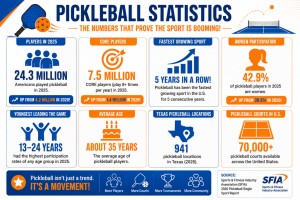
- 24.3 million: Americans played pickleball in 2025.
- 7.5 million: Core pickleball players played 8+ times in 2025.
- 42.9%: Women made up the pickleball player base in 2025.
- 13–24 years: This age group had the highest participation rate in 2025.
- About 35 years: Approximate average age of pickleball players.
- 941 locations: Pickleball locations were reported across Texas.
Pickleball Statistics Show a Sport Growing at an Extraordinary Rate
How Many People Play Pickleball in the U.S.?
The easiest way to understand pickleball’s rise is to look at participation over time.
According to the Sports & Fitness Industry Association (SFIA), 24.3 million Americans played pickleball in 2025. In 2020, the figure was only 4.2 million.
That’s a massive increase.
| Year | U.S. Pickleball Players |
| 2020 | 4.2 million |
| 2024 | 19.8 million |
| 2025 | 24.3 million |
The jump from 2024 to 2025 alone added approximately 4.5 million participants.
That is enough to make the idea of pickleball being a fad look increasingly outdated.
SFIA says pickleball has remained the fastest-growing sport in the United States for five consecutive years.
And there is another interesting detail.
The people joining the sport are not all looking for the same thing.
Some want an easy recreational activity. Others want competitive matches. Some are looking for exercise. Others want a social community. And plenty simply discovered that pickleball is dangerously good at turning “I’ll play for an hour” into “Wait, what time is it?”
Source SFIA
Pickleball Is No Longer an “Older Person’s Sport”
One of the biggest misconceptions about pickleball is that it belongs primarily to older adults.
The latest numbers make that stereotype increasingly difficult to defend.
SFIA’s 2026 Pickleball Single Sport Report says players ages 13 to 24 had the highest participation rates of any age segment in 2025.
That’s a major shift.
The sport is attracting younger players while continuing to maintain strong participation among adults and older generations.
The result is a genuinely multi-generational sport.
You can have a teenager playing alongside a parent, a grandparent joining a doubles game, and a competitive adult training for a tournament, all on the same type of court.
That broad appeal may be one of pickleball’s biggest advantages.
Source SFIA
The Average Age of Pickleball Players Has Been Falling
So, what is the average age of pickleball players?
The answer depends on the source and year, but the trend is clear: the player base is getting younger.
The APP research reported an average player age of 34.8 years and noted that the average age had fallen from 38 in 2021.
An earlier SFIA report also found an average participant age of approximately 35, with the 25-to-34 age group representing the largest participant segment at the time.
More recent SFIA data takes the story even further by showing particularly strong participation among 13-to-24-year-olds.
So if someone tells you pickleball is only for seniors, you can politely hand them the statistics.
Women Are Becoming a Bigger Part of the Pickleball Community
The gender breakdown is changing as well.

SFIA’s latest report says women accounted for 42.9% of pickleball players in 2025, compared with 38.6% in 2020.
That represents meaningful growth in female participation.
It also helps explain why pickleball communities increasingly offer programming for a wide range of players rather than designing everything around one demographic.
A sport grows differently when people see themselves represented on the court.
More women playing means more women’s leagues, doubles groups, clinics, social events, competitive opportunities, and families getting involved together.
Source SFIA
Core Pickleball Players Are Growing Even Faster
Casual participation tells only part of the story.
The more interesting question is how many people keep coming back.
SFIA defines CORE pickleball participants as people who play eight or more times per year.
That group grew from 1.4 million players in 2020 to 7.5 million in 2025.
| Participation Type | 2020 | 2025 |
| Total players | 4.2 million | 24.3 million |
| CORE players | 1.4 million | 7.5 million |
That tells us something important.
Pickleball is not simply attracting curious first-time players.
A growing number of people are making it a regular activity.
And regular players need regular access to courts.
That’s where dedicated pickleball facilities become increasingly important.
Source PickleTile
More Players Mean More Pressure on Court Supply
You can have millions of people interested in pickleball, but they still need somewhere to play.
Court availability has become one of the biggest infrastructure questions surrounding the sport.
The Pickleheads 2025 guide reported more than 70,000 pickleball courts in the United States, including dedicated courts and other playing locations. It also reported more than 16,000 places to play at the beginning of 2025.
Texas stands out in that conversation.
The same report listed 941 pickleball locations in Texas, making it one of the leading states for pickleball facilities.
That growth makes sense when you consider the state’s population, climate, and expanding recreational sports culture.
But having courts available and having convenient, quality court access are two different things.
Source USA Pickleball
Dedicated Facilities Are Becoming More Important
A public court can be great.
But regular players often want more.
They want reliable access to courts, consistent playing surfaces, lighting, comfortable surroundings, organized open play, coaching, and events.
Texas Pickleball in Roanoke is designed around that type of experience.
Its facility includes eight premium indoor courts with cushioned acrylic surfaces, more than 21,000 square feet of open space, professional-grade lighting, and climate-controlled indoor access.
That matters because Texas weather does not always care about your pickleball plans.
An indoor facility gives players a consistent environment instead of making every game dependent on heat, rain, wind, or whatever surprise the forecast has decided to deliver.
You can explore the Texas Pickleball facility to see what the venue offers.
Pickleball Is Becoming More Competitive
The recreational side of pickleball may be what gets most people through the door, but competitive play is growing rapidly too.
Tournaments, leagues, DUPR-rated matches, coaching programs, and competitive clinics are giving serious players more ways to measure improvement.
This creates a natural progression:
Beginner Players Have More Ways to Get Started
The growth of a sport depends heavily on how easy it is for new players to enter.
Pickleball has an advantage here.
The basic equipment is relatively simple. The court is smaller than a tennis court. The rules can be learned quickly. And beginners can start having rallies without spending years developing a perfect stroke.
Texas Pickleball’s one-hour free beginner session is designed for first-time players and introduces rules, scoring, court positioning, and essential shots.
That kind of low-pressure introduction can make a big difference.
Instead of wondering whether pickleball is right for you, you can simply try it.
If you want structured instruction after that, the beginner clinic focuses on grip, footwork, serves, shot control, drills, and personalized feedback.
The Numbers Are Changing What Players Expect From Facilities
As participation grows, players become more selective.
When only a small number of people play a sport, almost any available court can feel exciting.
When millions play, expectations change.
Players start looking for:
| What Players Want | Why It Matters |
| Reliable court access | Less time waiting for a court |
| Indoor play | Consistent conditions year-round |
| Quality surfaces | Better movement and comfort |
| Professional lighting | Easier ball tracking |
| Open play | More opportunities to meet players |
| Coaching | Faster skill development |
| Events | Competition and community |
| Flexible booking | Easier scheduling |
This is where facility quality becomes part of the pickleball experience.
They are useful.
Paying for Court Access Can Be a Smart Investment for Regular Players
Let’s talk about the practical side.
You do not need to buy a membership to play at Texas Pickleball. The facility offers pay-as-you-go options for non-members.
That makes sense for occasional players.
But if you play several times a week, membership can become more useful.
Texas Pickleball’s membership options include different levels of court access, open play benefits, reservation privileges, advance booking windows, clinic discounts, and guest passes depending on the plan.
The Utility Goes Beyond “Unlimited Play”
A membership can provide value through several practical benefits.
More predictable access: Regular players can plan their week around available court time.
Advance booking: Getting access to booking windows earlier can be useful when popular sessions fill quickly.
Open play: Regular open play opportunities make it easier to meet different players.
Clinic savings: Players who want coaching may benefit from discounts on clinics.
Guest passes: Depending on the membership, you can bring friends into the experience.
This is not about buying something simply because it says “membership.”
It is about whether the benefits match how often you actually play.
If pickleball has become a regular part of your routine, explore Texas Pickleball membership options and see which option fits your playing habits.
Booking a Court Makes Regular Practice Easier
You do not need to wait for a lucky opening at a public court.
Texas Pickleball allows players to reserve courts online, including through its CourtReserve booking system. The facility also offers open play throughout the day for different ages and skill levels.
You can book a Texas Pickleball court or go directly to the online booking portal.
That convenience matters because improvement usually comes from repetition.
One great game is fun.
Twenty regular sessions are where your third-shot drop starts behaving itself.
Coaching Turns Participation Into Progress
Playing more is helpful.
Playing more with useful feedback is better.
Texas Pickleball’s coaching options are designed to support players at different stages of development. Beginners can work on fundamentals, while more experienced players can focus on strategy, precision, positioning, and competitive play.
The clinic program includes customized personal training for players who want targeted work on a specific shot, footwork, playing style, or competitive goal.
You can explore the Texas Pickleball coaches or view the clinic options to find a training route that fits your level.
Pickleball Statistics Reveal a Much Broader Player Base
The most interesting thing about today’s pickleball statistics may not be the total number of participants.
It is who those participants are.
SFIA says the sport is attracting players across all age groups, with 13-to-24-year-olds showing the highest participation rates among age segments in 2025. Women now represent 42.9% of players, and the CORE player population has grown dramatically.
SFIA’s Alex Kerman summed up the change this way:
“The story behind pickleball’s growth is no longer just about participation gains.”
Kerman, SFIA’s Senior Director and Head of Research, went on to describe the player base as broadening and diversifying, with younger generations, women, and highly engaged players contributing to the sport’s continued growth.
That is a useful way to look at pickleball.
The sport is not simply getting bigger.
It is becoming more varied.
What These Pickleball Statistics Mean for the Future
If current trends continue, pickleball will need more than players.
It will need infrastructure.
That means more courts, more facilities, more coaches, more leagues, more tournaments, more equipment, and more ways for beginners to transition into regular play.
It also means communities will need facilities that can serve different types of players.
A beginner may want a relaxed open-play session.
An intermediate player may want a clinic.
A competitive player may want a DUPR-rated match.
A family may want to book a private court.
A company may want to organize a team event.
A good facility can support all of those needs.
That is the bigger story behind the statistics.
Pickleball Is Becoming a Lifestyle, Not Just a Game
The easiest way to explain pickleball’s growth is to say that people enjoy playing it.
But the numbers suggest something deeper.
People are building routines around it.
They are joining clubs.
They are attending clinics.
They are competing in tournaments.
They are meeting friends through open play.
They are booking courts after work.
They are traveling for competitions.
They are buying equipment.
And, increasingly, they are making pickleball part of their social lives.
That is why the latest pickleball statistics matter.
They do not just tell us how many people picked up a paddle.
They show how quickly a recreational game has developed into a serious sporting community.
Frequently Asked Questions About Pickleball Statistics
How many people play pickleball in the U.S.?
According to the latest SFIA report, 24.3 million Americans played pickleball in 2025. That is up from 4.2 million in 2020.
What is the average age of pickleball players?
The average age depends on the source and research year. APP data report puts the average player age at approximately 34.8 years, while more recent SFIA data shows particularly strong participation among players ages 13 to 24.
Is pickleball still the fastest-growing sport?
Yes. SFIA says pickleball has been the fastest-growing sport in the United States for five consecutive years.
Are younger people playing pickleball?
Absolutely. SFIA’s latest report says players ages 13 to 24 had the highest participation rates of any age segment in 2025.
What percentage of pickleball players are women?
Women represented 42.9% of U.S. pickleball players in 2025, according to SFIA.
How many CORE pickleball players are there?
SFIA reported 7.5 million CORE pickleball players in 2025, defined as people who play at least eight times per year.
Is pickleball popular in Texas?
Yes. The Pickleheads 2025 statistics guide listed 941 pickleball locations in Texas, placing the state among the leading U.S. markets for pickleball facilities.
Where can I play pickleball in Roanoke, Texas?
Texas Pickleball operates a dedicated indoor facility in Roanoke with eight courts, cushioned acrylic surfaces, professional lighting, and climate-controlled access.
Can beginners play at Texas Pickleball?
Yes. Texas Pickleball offers a free one-hour beginner session, along with beginner clinics and additional training options.
Can non-members play at Texas Pickleball?
Yes. Texas Pickleball offers pay-as-you-go options for non-members, so you can play without committing to a membership.
Join the Pickleball Growth and Be Part of Pickleball’s League
You can read pickleball statistics all day, but the best way to understand the sport’s growth is to step onto the court yourself.
Texas Pickleball gives players in Roanoke a dedicated indoor place to do exactly that, with 5 AM–11 PM access, eight premium courts, open play, clinics, coaching, events, and flexible booking options.
Book your court, explore membership options, or check upcoming events.
The sport is growing fast.
You might as well grab a paddle and be part of the numbers.
