


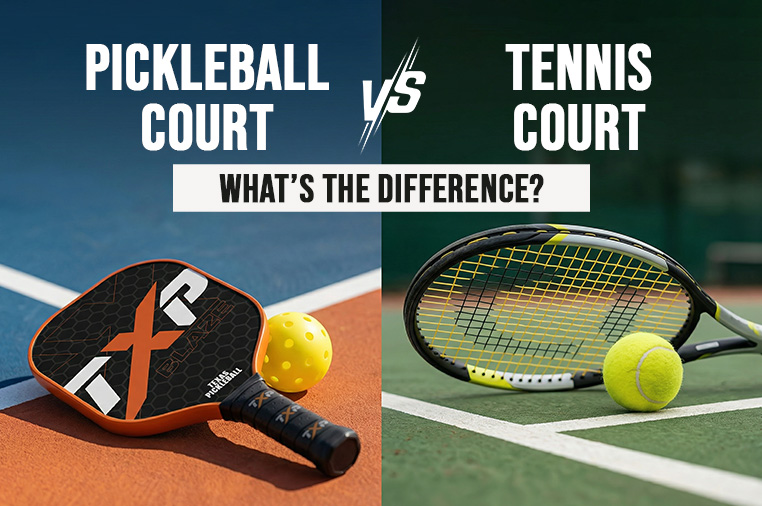
If you’ve ever stood on a tennis court and thought, “This feels a little too big for me,” or stood on a pickleball court and wondered why it feels like a giant game of ping-pong, you aren’t alone. As pickleball continues to take over neighborhoods and community centers, the comparison between the two sports is unavoidable.
While they both involve nets, balls, and paddles (or racquets), the actual playing environment is vastly different. Understanding the pickleball court vs tennis court debate is essential for any player looking to transition between sports or for facility owners deciding how to lay out their space.
In this guide, we’re going to break down everything you need to know about a pickleball vs tennis court, from the dimensions and net height to the surfaces and the “vibe” of the game.
1. The Most Obvious Difference: Size Matters
When you look at a pickleball court vs. a tennis court, the first thing you notice is the footprint. A tennis court is a massive piece of real estate. A standard tennis court for doubles play measures 78 feet long and 36 feet wide. When you add in the required “run-off” space (the area behind the baselines and sides), a single tennis court takes up about 60 by 120 feet.
A pickleball court, on the other hand, is much more compact. It measures 44 feet long and 20 feet wide. To give you a better visual: you can fit four pickleball courts inside the space of one single tennis court.
This difference in size changes the way the game is played. In tennis, you are covering a lot of ground, sprinting from side to side. In pickleball, the smaller court means less running and more quick-twitch reactions. This is why pickleball is often seen as a more “social” sport, you are literally standing closer to your partner and your opponents, making it much easier to chat (or trash-talk) between points.
For official court dimensions and guidelines, you can refer to the USA Pickleball court diagram.
2. The Lines: The Kitchen vs. The No-Man’s Land
The markings on the court are another major area of the pickleball vs tennis court comparison.
In tennis, you have the service boxes, the “alleys” for doubles play, and the baseline. There is no area on a tennis court where you are forbidden to stand. You can stand right at the net if you want (though it’s a risky strategy).
In pickleball, the lines define the most famous part of the game: The Kitchen (officially known as the Non-Volley Zone). This is a 7-foot area on both sides of the net. You cannot step into this zone to hit a ball out of the air (a volley). This rule was created specifically to prevent tall players from standing at the net and smashing every ball down. It forces players to play a “soft” game, known as dinking.
3. Net Height: The Inch that Changes Everything
At a quick glance, the nets look the same, but the height is a critical distinction in the pickleball court vs. the tennis court breakdown.
- Tennis Net: A tennis net is 36 inches high at the center and 42 inches high at the posts.
- Pickleball Net: A pickleball net is 34 inches high at the center and 36 inches high at the posts.
While a two-inch difference might not sound like much, in a game played with a plastic ball that doesn’t bounce nearly as high as a tennis ball, those two inches are everything. The lower net in pickleball allows for those sharp, cross-court angles and ensures the game stays fast and accessible for players of all heights.
4. Surface Materials: Where Do You Stand?
If you’re comparing a pickleball vs tennis court, you’ll find that tennis has a lot more variety. Tennis can be played on grass (like Wimbledon), clay (like the French Open), or hard courts (concrete or asphalt with an acrylic coating).
Pickleball is almost exclusively played on hard courts. Because the pickleball itself is made of perforated plastic (like a wiffle ball), it needs a very firm, smooth surface to bounce properly. If you tried to play pickleball on a grass court, the ball would essentially die as soon as it hit the ground.
At a facility like Texas Pickleball, we use professional-grade acrylic coatings over concrete. This provides the “true bounce” that players need while being much easier on the joints than bare concrete.
5. Equipment: Paddles vs. Racquets
You can’t talk about the court without talking about what you bring onto it.
- Tennis: You use a stringed racquet and a pressurized, felt-covered rubber ball. These balls are designed to fly long distances and bounce high.
- Pickleball: You use a solid paddle (made of wood, composite, or carbon fiber) and a plastic ball with holes.
Because the pickleball doesn’t “fly” as well as a tennis ball, the court doesn’t need to be as long. If you tried to hit a pickleball with a tennis racquet on a full-sized tennis court, the wind would likely catch it before it even reached the net!
6. Can You Play Pickleball on a Tennis Court?
This is the most common question we get. The answer is yes, but with some adjustments. Many neighborhoods are now “multi-lining” their tennis courts. This means they keep the white tennis lines but add colored lines (usually blue or yellow) for pickleball.
However, playing on a converted court has its downsides:
- The “Visual Noise”: Having too many lines on the floor can be confusing during a fast rally.
- The Net Problem: If you use a tennis net for pickleball, it will be 2 inches too high in the middle. Serious players usually bring a “net strap” to pull the center of the tennis net down to the correct 34-inch height.
This is why dedicated facilities are becoming so popular. There is nothing like playing on a court that was built specifically for the sport.
7. The Social Dynamics
The final piece of the pickleball court vs tennis court comparison isn’t about feet or inches, it’s about the people.
Because you can fit four pickleball courts in the space of one tennis court, a pickleball facility feels much more crowded and energetic. In the space where 4 people would be playing tennis, you can have 16 people playing pickleball. This density creates a community atmosphere that is hard to find in tennis.
Summary Table: At a Glance
| Feature | Pickleball Court | Tennis Court |
| Dimensions | 20′ x 44′ | 36′ x 78′ (Doubles) |
| Net Height (Center) | 34 inches | 36 inches |
| The “Kitchen” | Yes (7 feet) | No |
| Ball Type | Plastic with holes | Pressurized rubber/felt |
| Primary Surface | Hard Court (Acrylic) | Hard, Clay, or Grass |
Final Thoughts
Whether you prefer the wide-open spaces of a tennis court or the fast-paced, strategic “chess match” of a pickleball court, both sports offer incredible workouts and great community vibes.
If you’re comparing single vs double pickleball, you’ll notice how court coverage and strategy shift; singles demands more movement and endurance, while doubles focuses on positioning, teamwork, and quick reactions. For players seeking a game that’s easier on the knees, highly social, and requires less sprinting, the pickleball vs tennis court debate often ends with a paddle in hand.
Ready to see the difference for yourself? Come visit our pro-style indoor courts and experience why the smaller court is making such a big impact!
