


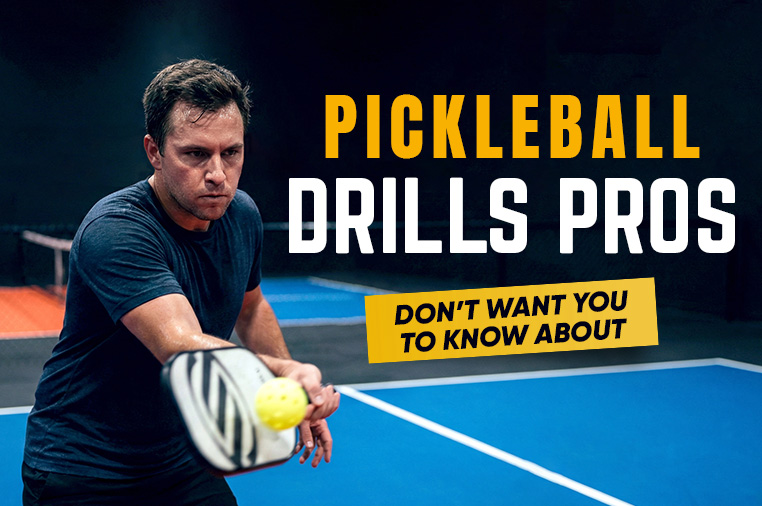
If you’ve ever sat on the sidelines of a pro tournament or even just watched Kings of the Court at Texas Pickleball, you’ve probably felt that slight sting of envy. You know the one. It’s the feeling you get when you see a player pull off a cross-court dink that barely clears the net, or a reset shot that turns a 50-mph drive into a harmless little puff of air.
It looks like magic. But here’s the secret: it isn’t.
Most pros aren’t “better” than you just because they are faster or stronger. They are better because they have trained their brains and bodies to respond to the ball automatically. While most recreational players spend their time just playing games, the elites are spending hours on specific pickleball drills that build “muscle memory” and “court IQ”.
Today, we’re pulling back the curtain. We’re going to talk about the drills that the top 1% use to keep their edge, the kind that don’t just make you hit harder but make you play smarter.
Why Are Drills Important?
Before we dive into the specific movements, let’s talk about why we drill at all. If you just play games every day, you might hit twenty backhand dinks in an hour. If you spend fifteen minutes on a focused drill, you might hit two hundred.
Drilling is about volume and intent. It’s about making the hard shots feel boring because you’ve done them so many times. The best pickleball drills are the ones that recreate the pressure of a real game without the consequence of losing a point.
Before we dive into the specific movements, let’s talk about why we drill at all. If you just play games every day, you might hit twenty backhand dinks in an hour. If you spend fifteen minutes on a focused drill, you might hit two hundred.
Drilling is about volume and intent. It’s about making the hard shots feel boring because you’ve done them so many times. The best pickleball drills are the ones that recreate the pressure of a real game without the consequence of losing a point.
If you want to explore more structured training systems and proven improvement methods used by competitive players, you can check this detailed guide on advanced pickleball drills and strategy.
1. The “Skinny Singles” Reset
This is a favourite among the elite because it forces you to master the most important part of the game: the transition zone.
The Setup: You and a partner stand diagonally from each other (cross-court). You only use half the court.
The Drill: One player starts at the baseline, and the other starts at the kitchen line. The baseline player must try to work their way up to the net by hitting “drops” or “resets”. The kitchen player’s job is to keep them back by hitting deep, aggressive volleys.
Why it’s a secret weapon: Pros love this because it removes the “noise” of a full court. It forces you to focus on your footwork and your “soft” hands. If you can move from the baseline to the kitchen while someone is firing balls at your feet, you will become unshakeable in a real match.
2. The “Non-Dominant” Hand Focus
Have you ever noticed how pros never seem to get jammed up on their “weak” side? That’s because they don’t have one.
The Drill: During a standard dink warmup, try to hit every third ball with your “weak” side, but focus entirely on your shoulder movement rather than your wrist.
The Goal: Most of us flick our wrists when we get nervous on our backhand. This drill teaches you to use your large muscle groups to push the ball over.
This is one of those pickleball drills for advanced players that feels awkward at first but pays off massively when you’re under pressure. When you stop “flicking” and start “pushing”, your errors will drop by half.
3. The “Figure-8” Dink
If you want to master court geometry, this is the one. Most people think straight ahead. Pros dink at angles.
The Setup: Two players in the kitchen. The Drill: Player A hits a cross-court dink. Player B hits a straight-ahead dink. Player A hits another cross-court dink. Player B hits another straight-ahead dink. The ball should essentially travel in a “Figure-8” pattern across the net.
Why it works: It teaches you to move your feet before the ball arrives. You learn how to adjust your paddle face to change the direction of the ball without changing your swing. This is the foundation of “manipulating” your opponent. You aren’t just reacting to where the ball is; you are choosing where it goes next.
4. The “Kitchen Chaos” Volley Drill
This is where the “hand speed” comes from. You’ve seen those rapid-fire volleys at the net that look like a ping-pong match on steroids? This is how they build that reflex.
The Setup: Both players at the kitchen line, standing slightly closer than usual.
The Drill: Start a rapid volley exchange. The goal isn’t to “win” the point, but to keep the ball moving as fast as possible for as long as possible.
The Twist: Every 10 hits, one player must intentionally hit a “dead” dink to slow the pace down, then immediately speed it back up on the next hit.
Why it’s elite: The hardest part of pickleball isn’t hitting fast; it’s switching from fast to slow and back again. Pros use this to train their brains to recognize “pace” instantly.
5. The “Third Shot” Gauntlet
You’ve heard it a million times: the third shot drop is the most important shot in the game. But pros don’t just practice the drop; they practice the drop under fire.
The Drill: Have your partner stand at the kitchen line with a bucket of balls. They should feed you balls at the baseline, not nice, easy bounces, but deep, hard drives. Your job is to drop 10 balls in a row into the “kitchen” (the non-volley zone). If you miss one, you start back at zero.
The Logic: Most of us practice drops with a ball machine or an easy toss. But in a game, that ball is coming fast. This is one of the best pickleball drills because it builds the mental toughness required to stay calm when a hard hitter is trying to “blast” you off the court.
6. The “Triangle” Dinking Strategy
This isn’t just a drill; it’s a mental blueprint.
The Concept: Imagine a triangle on your opponent’s side of the kitchen. One point is their left foot, one is their right foot, and one is the middle of the net.
The Drill: Practice hitting your dinks specifically to those three points in a random order.
- Hit the left foot.
- Hit the right foot.
- Hit the middle.
The Secret: When you aim for the feet, your opponent has to “reach” or “crouch”. When they are moving, they aren’t attacking. Pros don’t dink to the “court”; they dink to the “feet”. It’s a subtle shift that changes the entire game.
How to Build Your Own Practice Routine
You don’t need four hours a day to see results. If you have thirty minutes before your next social game, try this “Pro-Approved” routine:
- 5 Minutes: Straight-ahead dinking (finding your rhythm).
- 5 Minutes: Cross-court dinking (working the angles).
- 10 Minutes: Third-shot drops from the baseline (building the “soft” game).
- 10 Minutes: Skinny Singles (playing for “keeps” in a small space).
By the time you step into your actual match, your hands will be warm, your eyes will be sharp, and your confidence will be through the roof.
Texas Pickleball Events & Training Sessions
Practice at Texas Pickleball
Want to apply these pickleball drills in a real training environment? Visit Texas Pickleball and put these advanced strategies into action on the court.
Common Mistakes to Avoid
Even when doing the best pickleball drills, players often fall into “lazy habits”. Keep these three things in mind:
- Move Your Feet: Don’t reach for the ball. Step to it. Your paddle should stay in front of your body.
- Watch the Ball: It sounds simple, but most people look at where they want the ball to go instead of looking at the ball hitting their paddle.
- Stay Low: Pickleball is played from the ground up. If you stand up straight, you lose your balance and your power.
Final Thoughts: The “Pro” Mindset
The biggest “secret” pros have isn’t a special paddle or a hidden technique. It’s consistency. They are willing to do the “boring” work so they can do the “exciting” things during a match.
If you start incorporating these pickleball drills for advanced players into your weekly routine, you’ll notice something strange. The game will start to feel slower. You’ll have more time to think. Those moments that once felt like “unreachable” shots will start becoming manageable because you’re applying advanced pickleball strategies without even forcing it.
That’s when the shift really happens. You stop just reacting and start controlling the pace, spacing, and shot selection. In other words, you begin to play with intention instead of impulse.
You don’t have to be a professional to train like one. You just have to be willing to step on the court with a plan.
So, next time you’re at the facility, don’t just ask, “Who’s playing?” Ask, “Who wants to drill?” That’s the moment your game truly changes.
See you on the courts!
Follow us on social media and be part of the Texas Pickleball community.
Instagram
Facebook
TikTok
YouTube
